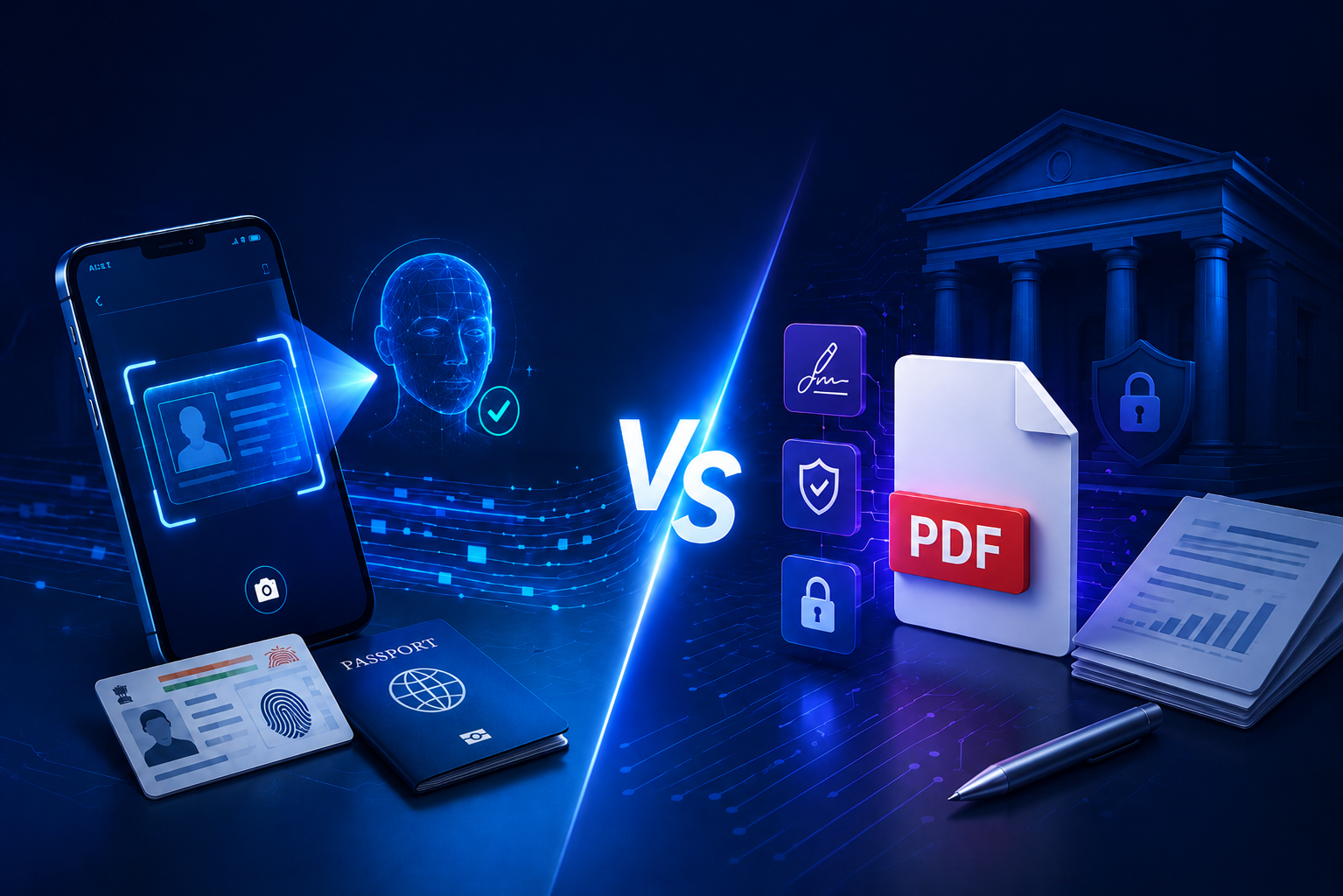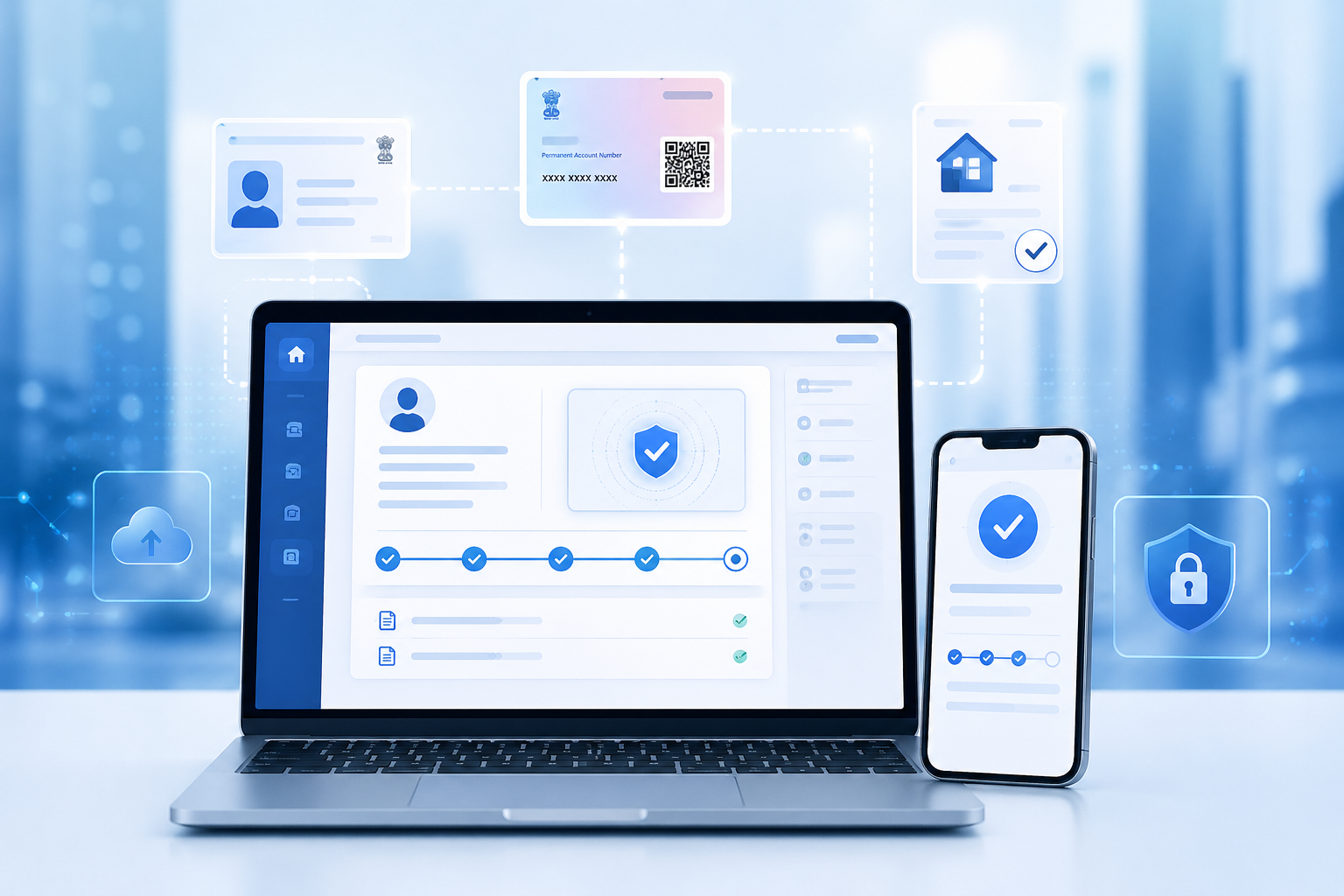
Customer abandonment during onboarding remains one of the biggest growth challenges for fintechs and NBFCs. Lengthy verification processes, repeated document submissions, compliance requirements, and fraud risks can significantly impact customer acquisition and operational efficiency.
As digital lending and financial services continue to expand, organizations need onboarding systems that balance speed, compliance, and customer experience.
A modern DMS helps fintech businesses and NBFCs store and manage customer documents — IDs, photos, and forms — digitally in one secure place, making digital KYC onboarding faster, reducing delays, and supporting compliance requirements.
Today, Aadhaar-based eKYC, Video KYC (V-CIP), DigiLocker integration, and CKYC enable fully digital customer onboarding while maintaining compliance with RBI regulations.
RBI guidelines allow soft copies of Aadhaar, PAN, passport, and DigiLocker documents — and with over 87% of payments being digital, the need is clear. A DMS connects everything through OCR, AI, and workflows, enabling real-time capture via a mobile data extraction SDK and ensuring KYC compliance via a KYC compliance SDK.
How DMS Drives Fast and Secure Onboarding?
Digital KYC is the process of verifying a customer’s identity using online methods. It includes Aadhaar-based verification, video calls, and document uploads. Instead of visiting a branch, users — whether they are customers of a fintech app or an NBFC — can complete everything from their phone or laptop. This makes onboarding faster and more convenient.
A DMS plays a key role in this process. It collects documents, stores them securely, and ensures they are easy to access. With the help of document management software, fintech platforms and NBFCs can handle thousands of applications without confusion or delays. The system ensures that every document is properly organized and linked to the right customer.
RBI KYC Norms and Guidelines
The Reserve Bank of India (RBI) has made KYC compliance mandatory for fintechs and NBFCs. The latest RBI KYC guidelines (Master Directions 2024/25) strengthen customer verification standards for all regulated entities and clearly define the RBI KYC norms for NBFCs operating in India.
These rules support digital onboarding by allowing soft copies of documents from DigiLocker or government-authorized apps. Fintechs and NBFCs can use Aadhaar-based eKYC (OTP or biometric), verified e-documents, or follow Video KYC compliance India requirements during customer onboarding.
Key RBI norms include:
- Expanded document list — RBI allows PAN, Aadhaar, passport, driver’s license, voter ID, and utility bills or DigiLocker e-documents for KYC. This flexibility means fintechs and NBFCs can accept images or PDFs of IDs and still meet norms.
- Risk-based checks — Banks and NBFCs must categorize customers by risk and do periodic KYC updates accordingly. High-risk customers get more frequent reviews to improve fraud control and compliance accuracy.
- Digital & Inclusive KYC — Video KYC is now a major onboarding method for fintechs and NBFCs. Under the Video KYC compliance India guidelines, RBI requires live face matching, document verification, and session recording during V-CIP. It also supports accessible onboarding for underserved users.
- Centralized KYC (CKYC) — RBI introduced CKYCR to simplify verification. The CKYC verification process stores customer KYC details under a unique CKYC ID, reducing repeated submissions across financial institutions and improving onboarding efficiency.
RBI guidelines make digital KYC onboarding mandatory with proper checks. Fintech apps and NBFC platforms onboard users online using Aadhaar scans or video KYC. Documents are stored in the DMS, and as a digital document management system, it verifies them via OCR and securely saves them.
The Role of Document Management in Onboarding
A Document Management System (DMS) works like a smart digital filing system. It stores IDs, selfies, and proofs securely with audit trails, while also automating onboarding steps.
For example, Extrieve’s PowerFile DMS combines document management, workflow automation, OCR-based extraction, audit trails, and compliance controls in a single platform. It helps fintechs and NBFCs streamline onboarding operations while maintaining security, regulatory compliance, and operational scalability.
As users submit data, the document management software captures and organizes everything instantly. It enables quick search, strong access control, and secure storage, even at a large scale.
A digital document management system also supports KYC workflows. It uses OCR for eKYC document processing to extract details from Aadhaar or other IDs. With a mobile data extraction SDK, users can scan documents, auto-fill forms, and reduce errors — making onboarding faster and easier for fintechs and NBFCs alike.
Below is an example comparison of traditional vs modern KYC onboarding to illustrate the difference:

| Aspect | Traditional KYC Onboarding | DMS-powered Digital KYC Onboarding |
| Process time | Days to weeks | Minutes to hours |
| Document handling | Physical forms, manual filing | Digital uploads, automated indexing |
| Fraud Detection | Manual Verification | AI-assisted validation |
| Customer effort | Branch visits, paperwork | Mobile/web uploads, instant OTP/biometric |
| Error rate | Higher (manual errors) | Lower (automated validation) |
| Compliance checks | Manual review by staff | Automated SDKs and rule-based checks |
| Audit trail | Potentially incomplete logs | Full digital logs and verifications |
| Examples | Local bank opening, ink signatures | Aadhaar eKYC scans, video KYC sessions |
By replacing paper with digital records, fintechs and NBFCs speed up approvals. An AI-driven DMS captures data via a mobile SDK, stores files securely, and applies rules through a KYC compliance SDK.
Using DMS for Fintech and NBFC-Specific Needs
Fintech firms and NBFCs need more than basic storage — they need KYC-focused features built for document-heavy, compliance-driven onboarding environments. Extrieve’s PowerFile DMS manages and organizes large volumes of onboarding documents with accuracy and compliance in mind, functioning as a true KYC document management system with added checks and templates.
It classifies documents like Aadhaar, PAN, and passport, flags missing details, and ensures compliance before approval — whether for a digital lending fintech or a high-volume NBFC. It also supports Aadhaar Masking, hiding the first 8 digits and showing only the last 4, keeping stored data secure without extra effort.
Through built-in document workflow software, documents move through upload, review, and approval stages. Real-time dashboards track progress, while AI can suggest missing files or auto-approve low-risk cases — making onboarding faster for both fintech and NBFC teams.
In summary, a fintech’s or NBFC’s DMS helps by:
- Ensuring document completeness (no missing ID or address proof).
- Validating documents via OCR/AI (checking format and data).
- Automating filing and retrieval, so any employee or service can find the needed KYC files instantly.
- Securing access and audit trails so that regulators can review KYC processes at any time.
- Reducing errors and cost, since less manual handling is required.
All of these combine to make digital KYC onboarding far faster and more reliable.
Benefits of Using DMS for Fintech and NBFC KYC
Beyond document storage, a modern DMS directly impacts business performance by reducing onboarding turnaround time, minimizing manual intervention, improving compliance readiness, and enhancing customer experience.
- Faster Processing: Processes KYC requests in minutes, reducing delays and speeding up customer onboarding significantly.
- Fewer Errors: Automation reduces manual input mistakes, ensuring accurate data capture and verification every time.
- Stronger Compliance: Built-in checks ensure all processes follow RBI guidelines, reducing risks and penalties effectively for fintechs and NBFCs.
- Better Experience: Customers enjoy quick, smooth onboarding without paperwork, improving satisfaction and overall engagement levels.
- Secure Storage: Stores documents safely with encryption, allowing quick and easy retrieval whenever required.
- Lower Costs: Reduces manual work and paperwork expenses, helping fintechs and NBFCs save operational costs over time.
These benefits help fintech companies and NBFCs scale quickly while maintaining quality.
For high-volume onboarding teams, these improvements translate into faster customer activation, lower operational costs, improved audit readiness, and reduced customer drop-offs.
Looking to Simplify Digital KYC Onboarding?
Discover how Extrieve PowerFile DMS helps fintechs and NBFCs reduce onboarding delays, strengthen regulatory compliance, automate KYC workflows, and improve customer conversion rates.
Explore PowerFile DMS →Powering Seamless KYC: Aadhaar eKYC, Video KYC, and CKYC in Action
Modern KYC onboarding uses Aadhaar-based eKYC, video calls, and the CKYC registry to ensure fast and compliant verification. Both fintechs and NBFCs offer multiple options, and a DMS manages all of them smoothly.
Aadhaar eKYC
It uses UIDAI data to verify users through OTP or biometrics. The system fetches basic details like name and address instantly, removing manual checks. A DMS stores this data and extracts key fields automatically.
In this process, eKYC document processing happens within the system, making verification quick and accurate. It also supports Aadhaar masking to protect sensitive customer information during storage and sharing.
Video KYC (V-CIP)
RBI-approved Video KYC allows users to verify identity through a live call. Customers show their ID and face, which are checked using visual and facial recognition methods.
A DMS securely stores video recordings, screenshots, and details, making compliance and audits easy for both fintechs and NBFCs. Advanced OCR solutions also help extract and validate document data faster during verification.
Video KYC steps typically flow like this:
- Initiation: The customer clicks “Start Video KYC” in the app. They may already be partially onboarded (like having entered basic info).
- Document submission: Before or during the call, the customer uploads or shows ID documents (Aadhaar, DL, etc.). These can be pre-checked by OCR for obvious issues (e.g., photograph presence).
- Live interaction: A KYC agent (or an AI bot) asks the customer to show their face and ID. The system may prompt the customer to blink or turn to ensure liveness (anti-spoofing).
- Face match & liveness: AI compares the live video frame to the ID photo. If they match and liveness is confirmed, the system flags the verification as positive.
- Recording and storage: The entire session and any presented documents are saved in the DMS, creating an audit trail.
CKYC – Central KYC

The Central KYC Registry (CKYCR) is a government initiative to avoid duplicate KYC across institutions. Once a customer completes full KYC with one entity — be it a fintech or an NBFC — their KYC details are uploaded to the central registry, which issues a 14-digit CKYC number.
Any other bank, fintech, or NBFC can then fetch that customer’s verified KYC data using the CKYC number (with customer consent). This eliminates repeated paperwork. Learn how this works at scale in this CKYC automation case study.
CKYC onboarding goes like this:
- Customer submits KYC to a financial institution (with all required documents).
- The institution verifies and sends the data to the CKYCR.
- CKYCR provides a unique KYC ID to the customer.
- For future accounts, the customer shares this KYC ID; the new institution downloads the KYC info from CKYCR.
Modern onboarding platforms also use a mobile SDK to simplify document scanning, image capture, and real-time data extraction during KYC.
A robust compliance management framework helps regulated financial institutions maintain audit trails, enforce policy controls, reduce fraud exposure, and remain aligned with evolving RBI requirements.
A DMS stores the CKYC ID and links it to the user profile. It fetches data using the CKYC number. This is CKYC compliance automation — auto-filling forms and asking for new documents only if needed. It saves time and reduces dropouts. With a KYC compliance SDK, data stays accurate and updated.
In short, for Aadhaar eKYC, Video KYC, or CKYC, a DMS manages everything. It handles OTP checks, stores records, fetches data, and ensures compliance with RBI KYC norms — whether the regulated entity is a fintech platform or an NBFC.
Industry Trends and Statistics
India’s fintech revolution is massive. According to a collaborative industry report by Unified Fintech Forum and CRIF High Mark, digital transformation continues to reshape the fintech and NBFC landscape in India, increasing the importance of secure digital KYC processes and efficient document management systems (DMS) across financial services.
Below are some key industry statistics that highlight why these solutions are so important:
| Metric | Value & Context |
| Fintech share of small personal loans | ~90% of personal loans under ₹1 lakh are originated by NBFC fintechs. (Fintechs dominate small-ticket lending.) |
| NBFC-Fintech growth (Q1 FY2026) | 34.9% YoY growth in fintech-NBFC loan portfolios, vs. 24.5% in overall NBFCs. (Shows fast fintech expansion.) |
| NBFC-Fintech borrowers | 2.8 crore active borrowers by mid-2025, up 47% from June 2023. (Millions more customers onboarded.) |
| Young borrower base | 65% of NBFC fintech borrowers are under 35 years old (June 2025). (Youth favor digital channels.) |
| Digital payments adoption | 87% of Indians use digital payments (FY2025). (Wide acceptance of digital finance via UPI, Aadhaar.) |
| Video KYC usage | After 2023, every new RBI-licensed fintech can use Video KYC by default (V-CIP implemented nationwide). (Video KYC is standard.) |
Source: Industry reports from CRIF High Mark, Unified Fintech Forum, RBI publications, and publicly available BFSI market research.
Tools and Integrations for Digital KYC
To achieve all of the above, fintechs and NBFCs combine DMS with specialized developer tools and APIs. These make the onboarding process modular and easy to integrate.
- Mobile SDKs for Scanning: A mobile data extraction SDK lets users scan IDs with their phone. It detects documents like Aadhaar or PAN and instantly extracts data, even offline, speeding up eKYC. Learn more about choosing the right scanning SDK for BFSI onboarding.
- KYC Compliance SDKs: A KYC compliance SDK automatically checks documents against RBI/AML rules. It verifies formats, detects errors, and ensures compliance within the DMS — a critical requirement for NBFCs under RBI’s Master Directions.
- Document Workflow Tools: Document workflow software automates approvals. If checks pass, onboarding completes instantly; if not, it moves to manual review with real-time tracking.
- API Integration: DMS APIs connect apps directly to the system. Documents are uploaded, processed, and updated in real time, creating a smooth user experience.
Step-by-Step Digital KYC Flow: From First Click to Final Approval

A typical digital KYC workflow using these tools — applicable to both fintech apps and NBFC onboarding portals — might be:
- Pre-Onboarding: Fintech app or NBFC portal verifies user’s basic info (name, phone). Checks if KYC ID (CKYC) already exists.
- Document Capture: User scans Aadhaar using the mobile SDK. App extracts data fields; user confirms them. The app uploads the Aadhaar image to the DMS.
- OCR & Extraction: DMS (or connected service) runs OCR on the image, verifies it matches the extracted data, and then applies Aadhaar masking before storage.
- Face Match (if selfie needed): User takes a selfie. The DMS sends the selfie and ID photo to a face-match API to ensure it’s the same person.
- Video KYC (if chosen): The user schedules a video call. The platform uses a video KYC solution to verify live (with recording). The recorded file is saved in the DMS.
- CKYC Check: The system uses the CKYC number (if provided) to pull existing KYC data. If found, it auto-fills fields and may skip some steps.
- Approval Workflow: Automated rules check all data (DOB, address, risk factors). If all checks are green, the user is approved. Otherwise, a human agent reviews the flagged items.
- Onboarding Complete: The DMS logs final approval and notifies the fintech’s or NBFCs’ core system. The user’s profile is now fully verified.
Throughout this, the DMS has enabled each step by storing data, running extraction, and enforcing workflows. This is the power of a digital KYC onboarding platform.
Challenges Without a DMS
Without a centralized onboarding and document management system, organizations often experience:
- Delays in customer onboarding and approval cycles
- Increased manual verification errors
- Higher compliance and audit risks
- Greater exposure to fraud and identity manipulation
- Poor customer experience and higher abandonment rates
- Increased operational costs and administrative overhead
Future of Digital KYC in India
The future of KYC in India is becoming fully digital, faster, and more intelligent. Technologies like AI, machine learning, and automation will continue improving how fintech companies and NBFCs verify customers, manage documents, and reduce risk.See how AI is modernizing document and invoice workflows in modern financial institutions.
As customer expectations grow, fintech businesses and NBFCs will increasingly rely on integrated systems to handle onboarding, compliance, and security smoothly.
- AI-Based Fraud Scoring: Advanced AI systems can quickly detect suspicious activities and reduce fraud risks during customer verification.
- Biometric Onboarding: Biometric verification methods like facial recognition and fingerprint scanning can improve security and speed up onboarding.
- Account Aggregator Ecosystem: The growing account aggregator ecosystem will allow secure and consent-based financial data sharing between institutions.
- Real-Time AML Verification: Real-time AML checks can help fintech companies and NBFCs improve compliance and identify risky transactions more efficiently.
A DMS will remain a central part of this transformation. It will continue supporting faster onboarding, better compliance management, secure document handling, and an improved customer experience for fintech companies and NBFCs across India.
Take the Next Step with Smarter KYC Systems
India’s fintech and NBFC ecosystem is expanding rapidly, but customer expectations and regulatory requirements are evolving just as quickly. Organizations need onboarding systems that can deliver speed, compliance, security, and scalability without compromising user experience.
With smart DMS platforms and SDKs, fintechs and NBFCs achieve digital KYC onboarding that is fast and reliable. Customers get a smooth signup, while companies see higher conversions and lower fraud. Onboarding drops from days to minutes.
In short, DMS powers onboarding through document management software, automating checks and integrating with RBI-approved tools — making the process digital, efficient, and compliant for every regulated entity in India.
As RBI compliance requirements continue to evolve and customer acquisition becomes increasingly competitive, automated onboarding platforms will become a strategic business necessity rather than an operational convenience.
Key Takeaways:
- Digital KYC onboarding makes customer verification faster, easier, and fully online.
- A Document Management System (DMS) is the backbone that manages, stores, and secures all KYC documents for fintechs and NBFCs.
- Technologies like Aadhaar eKYC, Video KYC, and CKYC simplify identity verification and reduce duplication.
- DMS helps fintechs and NBFCs stay compliant with RBI KYC guidelines through automation, audit trails, and secure storage.
- Automation tools like OCR, SDKs, and workflows reduce manual errors and speed up onboarding.
- Fintechs and NBFCs benefit from faster approvals, lower costs, better customer experience, and improved fraud prevention.
Ready to Accelerate Your Digital KYC Onboarding?
Eliminate delays, reduce manual errors, and simplify compliance with a powerful DMS built for NBFCs and FinTechs.
FAQs:
Digital KYC onboarding is the process of verifying a customer’s identity online using documents, Aadhaar, or video verification methods.
Yes, RBI approves Video KYC under its V-CIP guidelines. It allows fintechs and NBFCs to verify customers remotely through live video verification.
Aadhaar masking hides the first 8 digits of the Aadhaar number and shows only the last 4 digits to protect customer privacy and improve data security.
A DMS stores, organises, and verifies documents securely while automating workflows and ensuring compliance with regulations.
Aadhaar eKYC uses OTP or biometric authentication, while Video KYC verifies identity through a live video interaction.
CKYC is a central registry that stores verified KYC data, allowing customers to reuse their KYC across institutions — including both fintechs and NBFCs.
Yes, it is secure when supported by encryption, access controls, audit trails, and compliance with RBI guidelines. To understand how secure onboarding works in real fintech and NBFC environments, see Extrieve’s DMS in Action.