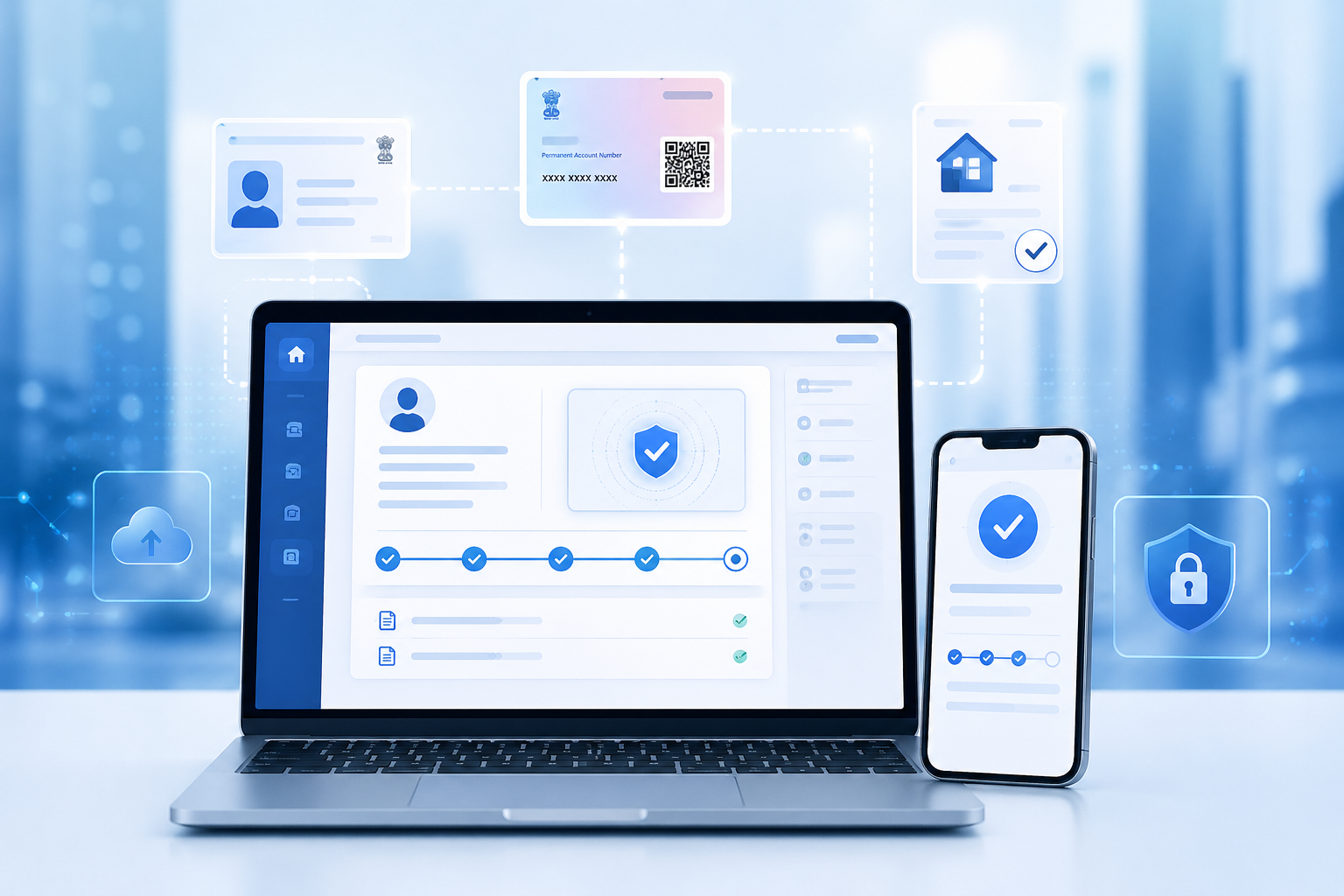
India’s banking industry is growing rapidly as digital banking adoption continues to increase across the country. Today’s customers expect faster and smoother banking experiences.
According to industry reports,digital loans accounted for nearly 80% of total loan volumes in India by Q1FY26, increasing the pressure on banks to manage high-volume document workflows efficiently.
At the same time, banks are handling large-scale CPC operations across expanding branch networks. However, manual document handling still creates operational delays and inefficiencies. With automation support from Extrieve, banks can improve efficiency, scalability, and operational consistency.
The Challenge of Managing High Document Volumes
Every day, financial institutions handle thousands of critical documents, including:
- Loan applications
- KYC verification forms
- Account opening documents
- Compliance and regulatory records
Many of these processes still depend heavily on manual handling and verification. As document volumes continue to grow, banks often experience:
- Branch-level inefficiencies
- Slow document verification
- Human errors during data entry
- Longer approval cycles
- Loan approval delays
- Rising operational costs
- Customer abandonment due to slow processing experiences
In a highly competitive banking environment, these challenges can directly affect customer satisfaction, operational efficiency, and overall business growth.
How Extrieve Helps Modern Banks
This is where intelligent document processing for banks becomes a powerful solution. Platforms like Extrieve help financial institutions automate document-heavy workflows, reduce manual effort, and improve processing accuracy.
By streamlining document management and verification processes, banks can build systems that are faster, smarter, and more reliable for both employees and customers.
Why Central Processing Centers Are No Longer Optional?
To manage growing workloads, banks have moved towards Central Processing Centers (CPCs). These centers are designed to handle high-volume operations in a centralized and structured way.
This shift has become increasingly important for PSU banks and other large financial institutions that manage operations across wide branch networks.
How CPCs Work

Instead of processing documents at individual branches, banks route them to CPCs, where trained teams manage important tasks such as:
- Verification
- Validation
- Approvals
With the growing retail banking scale in India and ongoing branch centralization trends, centralized processing models are helping banks improve operational consistency and efficiency.
Key Advantages of Centralized Processing Models
This approach offers several advantages:
- Standardized processes across locations
- Better control over operations
- Reduced duplication of work
- Improved monitoring and reporting
However, traditional CPCs are not perfect.

They often depend on manual processes, which limit their efficiency. Teams spend hours reviewing documents, entering data, and cross-checking information. As digital loan growth in India continues to rise, these inefficiencies become more visible and difficult to manage at scale.
To address this, banks are now combining intelligent document processing for banks with the evolving central processing center banking India model.
With the help of intelligent document processing software, CPCs can automatically read documents, extract relevant data, and validate it against predefined rules. This reduces manual effort and speeds up the entire workflow.
The Real Bottleneck: Manual Document Workflows
If you look closely at banking operations, most delays come from one place—manual document handling.
Every document goes through multiple steps:
- Collection
- Verification
- Data entry
- Cross-checking
- Approval
Each step involves human effort. And with human effort comes the risk of delays and errors.
In many banks, these manual workflows often lead to practical operational challenges such as loan disbursement delays, long KYC verification queues, and account opening backlogs. As customer volumes increase, handling these processes manually becomes more time-consuming and difficult to manage efficiently.
Manual workflows also create inconsistency. Different teams may follow different processes, leading to variations in output. This makes it harder to maintain quality and compliance.
This is where automation changes everything.
With document processing automation in banking, banks can eliminate repetitive tasks and replace them with intelligent systems.
These systems can:
- Capture data from scanned or digital documents
- Classify document types automatically
- Extract key information with high accuracy
- Validate data in real time
The result is faster processing, fewer errors, and more consistent outcomes. To understand how AI is driving this shift across document workflows, read: The Role of AI in Modernizing Document and Invoice Workflows.
Scaling Back-Office Operations Without Complexity
Growth brings opportunity, but it also brings operational pressure.
As banks expand their customer base, the volume of documents increases significantly. Managing this growth manually requires more staff, more time, and more resources.
This is not sustainable in the long run, which is why banks are adopting enterprise-grade document management capabilities to centralize operations while maintaining security, audit readiness, and faster document retrieval.
That’s why back office automation banking India is becoming a key focus area for financial institutions.
Automation allows banks to scale operations without increasing complexity. Instead of adding more people, they rely on systems that can handle higher volumes efficiently.
For instance, an enterprise document management system helps banks store, organize, and retrieve documents from a centralized platform. This eliminates the need for scattered storage systems and improves accessibility.
Similarly, workflow automation software ensures that tasks move seamlessly from one stage to another. Documents no longer get stuck in queues or lost in communication gaps.
This creates a smooth, connected workflow where every step is clearly defined and efficiently executed. Learn how workflow systems support this kind of growth in detail: How Modern Workflow Management Systems Transform Business Operations at Scale?
Improving Compliance Without Slowing Down Operations

Compliance is a critical part of banking. Regulations such as KYC and AML require banks to maintain strict standards when processing customer information. RBI compliance and audit-readiness are especially important for CPC operations that handle large-scale customer onboarding, CKYC workflows, and lending processes.
However, maintaining compliance manually is challenging. It increases the risk of errors and delays, which can lead to penalties, reporting issues, or reputational damage.
Automation offers a better approach.
With a document processing API, banks can integrate verification processes directly into their systems. This ensures that every document is checked against compliance requirements automatically while supporting smoother regulatory reporting processes.
At the same time, a workflow management system provides complete visibility into the process. Banks can track every document, monitor its status, and maintain a clear audit trail, which is essential for internal reviews, compliance monitoring, and regulatory accountability.
This not only improves compliance but also builds trust with regulators and customers.
Enhancing Customer Experience Through Faster Processing
Today’s customers expect speed and convenience. They do not want to wait days for account approvals or loan processing.
When banks rely on manual systems, meeting these expectations becomes difficult. Delays in document processing directly impact customer satisfaction.
Automation changes this dynamic.
With IDP integrated into CPCs, banks can process documents much faster. Applications move quickly from submission to approval, reducing turnaround time significantly.
Customers benefit from:
- Faster onboarding with improved onboarding conversion
- Quicker loan approvals and faster TAT for loans
- Real-time updates on application status with reduced turnaround time across processes
This creates a more seamless and satisfying banking experience.
The Measurable Impact of IDP in CPCs
The benefits of IDP are not just theoretical. Banks that adopt it see real, measurable improvements.
Some of the key outcomes include:
- Reduced processing time from days to minutes, helping banks improve workflow efficiency by 70–80% in high-volume workflows
- Automation improves processing performance while reducing compliance friction, manual errors, and false-positive alerts
- Operational accuracy improves significantly through automated data extraction, validation, and real-time verification processes
- Team productivity increases consistently as automated workflows reduce repetitive tasks and support better process optimization across departments
In addition, centralized and automated systems provide better data insights. Banks can analyze trends, identify bottlenecks, and make informed decisions faster.
This gives them a competitive edge in a rapidly evolving market. With advanced automation support from Extrieve, banks can achieve greater scalability while maintaining operational consistency.
Building a Future-Ready Banking Ecosystem

The banking industry is moving towards a digital-first future. Technologies like AI, machine learning, and automation are becoming essential for staying competitive.
Central Processing Centers will continue to play a key role, but they must evolve to keep up with changing demands.
By adopting intelligent document processing for banks, financial institutions can transform their CPCs into high-performance hubs. These centers become faster, more accurate, and capable of handling large volumes effortlessly.
Future-ready banking operations are increasingly focusing on advanced capabilities such as:
- AI-Led Risk Analysis: Banks can use AI to identify risk patterns, detect fraud, and support faster and more accurate credit assessments.
- Straight-Through Processing (STP): STP enables transactions and document workflows to move automatically through systems with minimal manual intervention.
- Real-Time Verification: Real-time verification helps banks instantly validate customer and document information, reducing delays in onboarding and lending workflows.
- Intelligent Banking Workflows: Intelligent workflows connect systems, teams, and processes to improve operational efficiency, visibility, and decision-making.
In the long run, combining IDP with bank document workflow automation ensures that every part of the document lifecycle is optimized. From data capture to final approval, the entire process becomes seamless and efficient.
This is how banks can build systems that are not just efficient today but also ready for the future.
Key Takeaways:
- Central Processing Centers help banks effectively manage large-volume operations
- Manual workflows for documents are the primary source of delays and mistakes.
- IDP enables faster, more accurate document processing
- Automation allows for scalability without raising operational costs
- Compliance is made easier by automated verification and monitoring
- Strong audit trails and centralized banking operations help banks support RBI compliance more effectively
- Improvements in workflows can lead to more positive customer experiences
FAQs:
Intelligent Document Processing is a technology that utilizes AI to process, extract, and validate information from documents in a way that is automated.
It helps reduce manual work. It speeds up handling documents and increases precision, which makes CPCs much more effective.
Absolutely, IDP solutions follow strict security and compliance requirements by the banking industry.
Yes, IDP can process various banking documents such as KYC forms, loan applications, account opening documents, and financial records.
The most significant benefit is faster processing, with greater precision, which results in improved efficiency and a better experience for customers.
IDP helps banks automate document verification, data extraction, and validation during loan processing. This reduces manual effort, speeds up approvals, minimizes errors, and supports faster loan disbursement.
Yes, modern IDP solutions can integrate with existing core banking systems, workflow platforms, and document management tools to support seamless operations without major infrastructure changes.
IDP helps banks maintain RBI compliance by automating verification processes, supporting CKYC workflows, improving regulatory reporting, and maintaining accurate audit trails for better transparency and accountability.